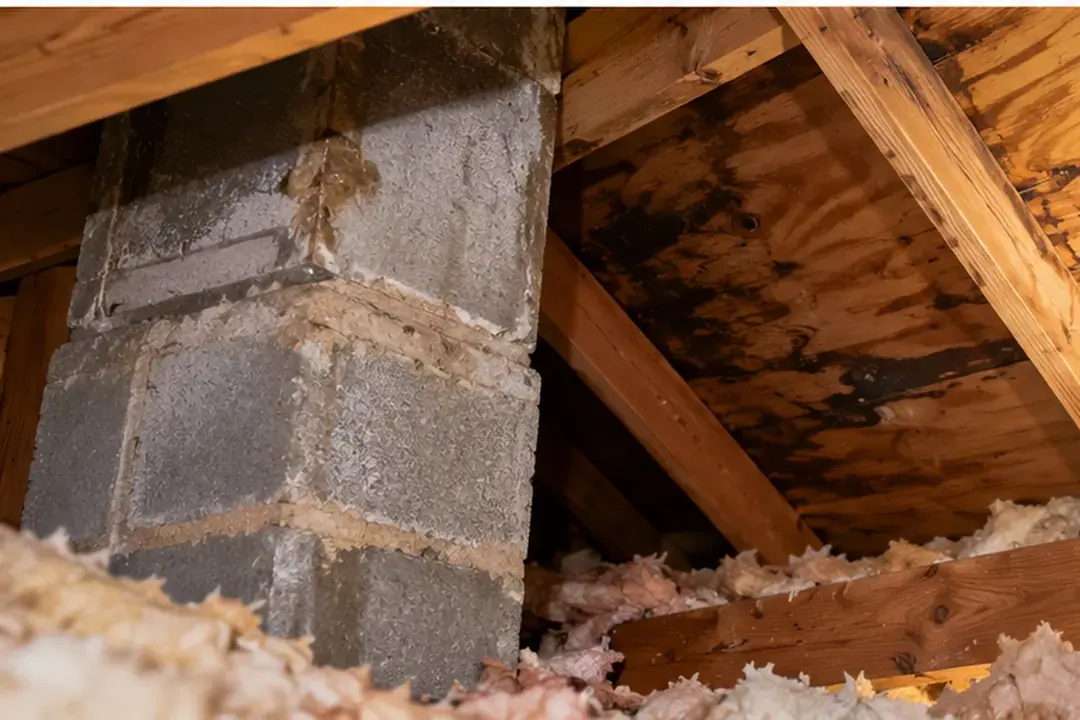
Staining beside the chimney
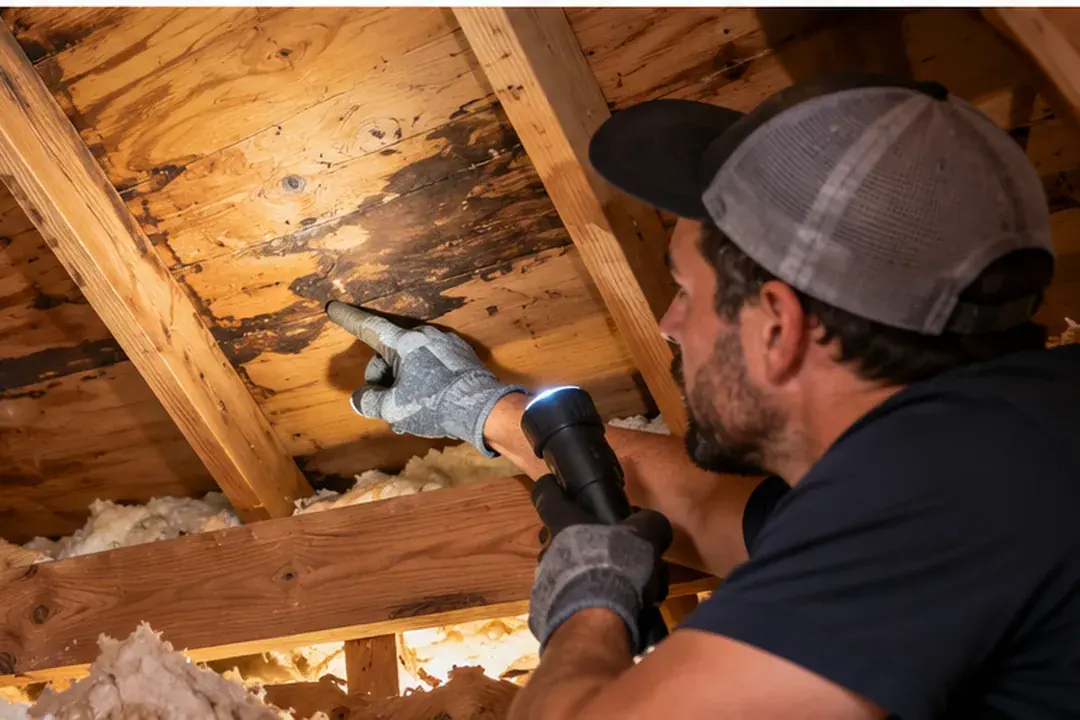
Damp decking, rafters, drywall, or ceiling material close to the chimney can be consistent with water entering at the roof-to-chimney intersection.

Updated October 3, 2026
A leak near a chimney can come from the flashing, surrounding shingles, masonry, chimney cap, or another roof detail. The useful question is not simply “Is the chimney leaking?” but which part of the chimney-roof intersection is allowing water in.
Chimney flashing is the water-shedding system where a chimney passes through the roof. On many shingle roofs, that system includes apron or base flashing at the downslope side, step flashing along the sides, and counterflashing attached to or embedded into the masonry so water is directed over the lower flashing rather than behind it.
A leak can develop when metal loosens, corrodes, cracks, pulls away from masonry, is installed with poor overlaps, or when the surrounding shingles or underlayment fail. Water can also enter through cracked masonry or the chimney cap and imitate a flashing leak.
A durable diagnosis considers the upper and lower flashing pieces, roof covering, masonry, sealant joints, and the path water takes around the chimney.
The location of moisture and the weather pattern can narrow the investigation, but no single sign proves the flashing is at fault.
Damp decking, rafters, drywall, or ceiling material close to the chimney can be consistent with water entering at the roof-to-chimney intersection.
Heavy runoff or wind-driven rain can reach upper, side, or counterflashing joints differently than a light shower.
If the upper flashing no longer covers the lower flashing correctly, water can move behind the assembly instead of being shed onto the roof.
Deteriorated metal deserves evaluation, especially when the same area is associated with recurring interior moisture.
Flashing can fail because of physical damage, age, corrosion, poor attachment, incorrect overlaps, or movement between the chimney and roof. Previous repairs can also complicate the system when roofing cement or caulk is layered over joints without correcting the underlying flashing detail.
At the same time, the flashing may be performing normally while the true water source is elsewhere. That is why a chimney leak should be investigated as a small roof system rather than treated as a single joint.
Water near a chimney can enter through more than the roof flashing. Cracked mortar joints, porous masonry, damaged chimney crowns, missing caps, or openings higher on the chimney can introduce water that later appears near the roof line.
Flashing becomes more suspect when the interior moisture tracks close to the roof-to-chimney joint and the exterior metal is loose, damaged, or poorly integrated. Masonry becomes more suspect when water is associated with cracks or deterioration higher on the chimney, although both problems can exist at the same time.
A correct repair should separate roof-entry paths from masonry-entry paths before materials are removed or resealed.
Step flashing is commonly woven into the shingle courses along the sides of a chimney. Counterflashing sits above it and covers the upper edge so water flowing down the chimney face cannot get behind the lower pieces. At the downslope face, apron flashing helps move water onto the roof surface.
If one part of that sequence is missing, damaged, or poorly overlapped, adding sealant to the visible edge may not restore the intended water path. Guidance from roofing manufacturers emphasizes proper overlap and replacement of deteriorated flashing rather than treating caulk as the flashing itself.
A localized repair may be possible when the flashing system is fundamentally correct, surrounding roofing is serviceable, and the problem is limited to a specific loose or damaged component. Broader replacement becomes more likely when the metal is rusted through, cracked, hole-filled, repeatedly patched, incorrectly installed, or tied into deteriorated shingles or underlayment.
Existing counterflashing can sometimes be reused when it remains in good condition. Manufacturer guidance recommends replacing deteriorated counterflashing, including rusted, cracked, or hole-filled metal. The actual choice should be based on condition and how the flashing is integrated into the chimney and roof.
May make sense when one accessible piece is loose or a specific joint can be restored without dismantling a larger system.
Becomes more appropriate when metal is deteriorated, the overlap sequence is wrong, or previous repairs cannot be reliably integrated.
May be necessary when shingles, underlayment, or decking have been damaged by the same leak.
Is separate from flashing work when the water is entering through mortar, crown, cap, or another chimney component.
Sealant is useful at selected joints, but it is not a substitute for correctly installed flashing. A surface bead can temporarily reduce water entry while leaving a bad overlap, loose metal, or hidden gap unchanged. Repeated layers can also make the original detail harder to inspect.
If the chimney has been caulked several times and the leak keeps returning, the next step should be diagnosis of the flashing and surrounding materials rather than another identical patch.
The roof should still shed water correctly even before a cosmetic layer of patch material is considered.
Central Florida thunderstorms can deliver high rainfall rates and wind that pushes water against vertical masonry. A chimney creates multiple directions of runoff: water reaches the upslope side, moves along both sidewalls, and exits downslope. A weak point may remain dry in light rain yet leak when the volume or wind angle changes.
When documenting a Lakeland chimney leak, note whether the moisture appears during every rain, only in heavy rain, or mainly when wind comes from a particular direction. That information can help guide the exterior inspection later.
Useful information includes the room or attic location where water appears, whether the stain is beside the upslope, side, or downslope face of the chimney, whether the leak happens only during certain storms, and whether previous flashing or masonry repairs have been attempted.
You do not need to identify step flashing or counterflashing yourself. A short record of the leak pattern is more useful than guessing at a component.
No. The flashing is one common possibility, but masonry, chimney caps, nearby shingles, underlayment, and other roof details can produce similar interior symptoms.
Yes. Increased runoff and wind-driven rain can expose an opening that does not receive enough water to leak during a light shower.
Sometimes. If the metal remains sound and compatible with the repair, reuse may be possible. Deteriorated, rusted, cracked, or hole-filled counterflashing is a stronger candidate for replacement.
A small surface crack may look simple, but rooftop work carries fall risk and a visible joint may not be the actual water path. Ground-level documentation and professional inspection are safer when the leak is recurring.
These references provide general technical context. They do not replace inspection of a specific roof or chimney.
Describe when the leak appears and which side of the chimney is closest to the moisture so the likely water path can be narrowed before materials are opened.