Loose or lifted metal
Flashing that no longer sits tight against the roof or adjoining surface can allow water to move behind the detail instead of being directed downslope.

Updated October 3, 2026
Flashing protects roof transitions where shingles alone cannot keep water out. When it fails, the first clue may be a ceiling stain, damp attic decking, or a leak that appears only during stronger rain. The pattern matters more than the stain by itself.
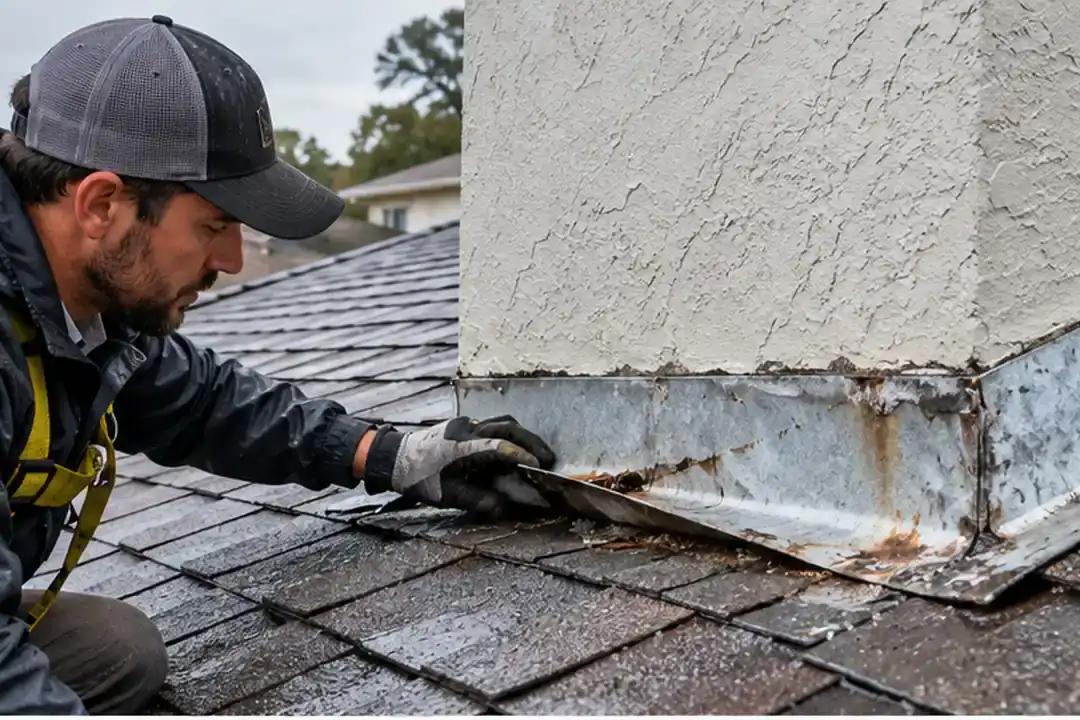
Common flashing-leak clues include water stains near a chimney, exterior wall, vent, skylight, or another roof penetration; damp roof decking in the attic near one of those transitions; visible loose, bent, corroded, or separated flashing; and leaks that become more noticeable during heavy or wind-driven rain.
None of those signs proves that flashing is the only problem. Nearby shingles, sealants, masonry, pipe boots, skylight components, or underlayment can create similar symptoms. The goal is to narrow the water path before deciding what should be repaired.
If the interior moisture is close to a place where the roof meets a wall, chimney, vent, skylight, or another penetration, flashing deserves inspection—but it should be evaluated with the surrounding roof materials, not in isolation.
Flashing problems are not always dramatic. Small changes at a transition can become meaningful when several clues appear together.
Flashing that no longer sits tight against the roof or adjoining surface can allow water to move behind the detail instead of being directed downslope.
Metal deterioration can weaken flashing and create openings. Rust alone does not prove active leakage, but it is a reason to inspect the surrounding joint carefully.
Some flashing systems use sealant at specific joints. Failed sealant can expose a vulnerable seam, but adding more caulk is not a substitute for correctly overlapped flashing.
A stain that darkens during rain and dries between storms suggests active water entry somewhere in the roof system. Its location can help narrow the inspection area.
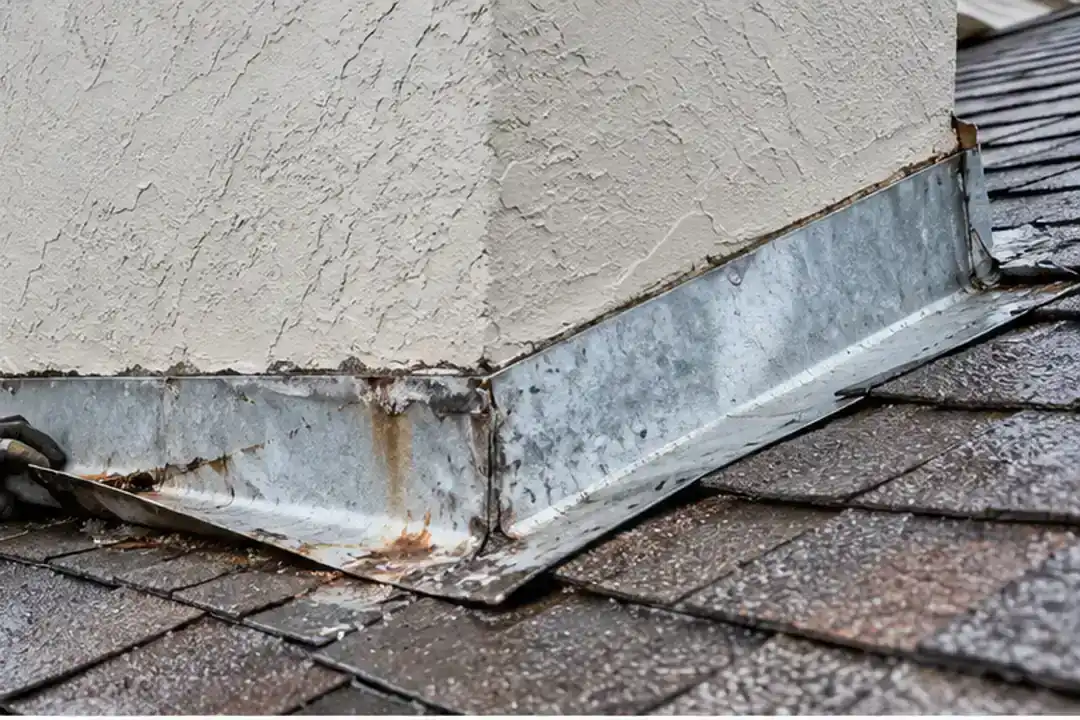
Flashing is used where water has to move around a change in roof geometry or a penetration. That is why leak investigations often focus on chimneys, roof-to-wall intersections, vents, skylights, dormers, valleys, and other places where one building surface meets another.
Different locations use different details. Step flashing is commonly interwoven with shingles at sidewalls. Chimneys may combine base or apron flashing, step flashing, and counterflashing. Vents and pipes use boots or collars. Skylights rely on manufacturer-specific or site-built flashing systems integrated with the roofing.
Water can enter at one point and travel along roof decking, rafters, fasteners, insulation, or the top of drywall before it becomes visible. That means an interior stain is evidence of moisture, not a precise map to the roof opening.
A stain several feet away from a chimney or wall transition can still be related to flashing if the water entered higher on the roof and moved before dripping. The reverse is also true: a stain near a chimney may come from masonry, a cap, nearby shingles, or another roof detail rather than the flashing itself.
The better approach is to compare the interior moisture path with exterior roof transitions, the direction of runoff, and the weather conditions that trigger the leak.
Light rain and stronger storms do not load a roof in the same way. Higher runoff volume can send more water toward a chimney, wall, valley, or penetration. Wind can also push rain against vertical surfaces and into joints that stay dry in calmer conditions.
For Lakeland homeowners, recording whether the leak appears in every shower or only during stronger thunderstorms is useful diagnostic information. A storm-only leak does not automatically mean the flashing is bad, but it can help narrow which transitions deserve closer attention.
This can suggest the roof handles ordinary runoff but struggles when water volume rises.
Water driven toward a wall, chimney, or penetration can expose a weak side or upper joint.
A delayed leak can reflect water accumulating or traveling before it becomes visible indoors.
A consistent pattern is valuable evidence when the roof is inspected later under dry conditions.
Start inside. Photograph the stain or damp area, note the time and weather, and look from the attic only if access is safe. From the ground, binoculars or a zoom camera can sometimes reveal loose metal, lifted edges, damaged shingles, or obvious gaps around a chimney or wall transition.
Do not climb onto a wet or storm-damaged roof to confirm a flashing problem. The value of homeowner observations is in documenting the pattern, not performing a rooftop diagnosis.
Professional evaluation becomes more useful when the leak repeats, flashing is visibly loose or damaged, previous surface patches have failed, interior finishes are being damaged, or the water source remains uncertain. The repair may be localized if the surrounding roof remains serviceable, but damaged decking, underlayment, shingles, masonry, or multiple transitions can increase the scope.
Sealant can be part of a repair at the right joint, but reputable flashing guidance treats it as secondary protection rather than a replacement for correctly integrated metal and roofing. If the leak has already been narrowed to a transition, the Roof Flashing Repair in Lakeland page explains the service process in more detail.
A durable repair should restore the way water is directed over and away from the roof transition.
Skylight leaks can involve flashing, nearby shingles, glazing, seals, frames, or condensation. If the moisture is specifically around a skylight, use the Skylight Leak Repair service page or the condensation-vs-leak guide instead of assuming every skylight problem is flashing.
If the leak is broader and the component is not yet known, start with the homepage's Roof Leak Repair in Lakeland guidance.
Yes. The problem can involve hidden overlaps, attachment points, surrounding roofing, underlayment, or a joint that is not visible from the ground. Appearance alone does not confirm performance.
Not every surface stain means the flashing has failed, but rust, holes, cracks, or deterioration are reasons to evaluate whether the metal can still perform as intended.
Sealant may be appropriate at selected joints, but it does not replace step flashing, counterflashing, proper overlaps, or correctly integrated roof materials. Repeated caulking can also hide the original leak path.
Yes. Ongoing water entry can wet decking, insulation, drywall, and other materials. The repair scope depends on how long the leak has been present and what materials were affected.
These references provide general technical context. They do not replace inspection of a specific roof.
Describe where the moisture appears and which chimney, wall, vent, skylight, or transition is nearby so the likely water path can be narrowed before repair.