Blocked or restricted drains
Leaves, roof debris, organic buildup, or objects around a drain or scupper can slow discharge and cause water to back up across the membrane.

Updated October 3, 2026
Water sitting on a flat or low-slope roof after a storm can point to drainage, slope, drain, membrane, or structural conditions—but not every temporary puddle means the roof is leaking. The useful question is how long the water remains, where it collects, and what condition the surrounding membrane is in.
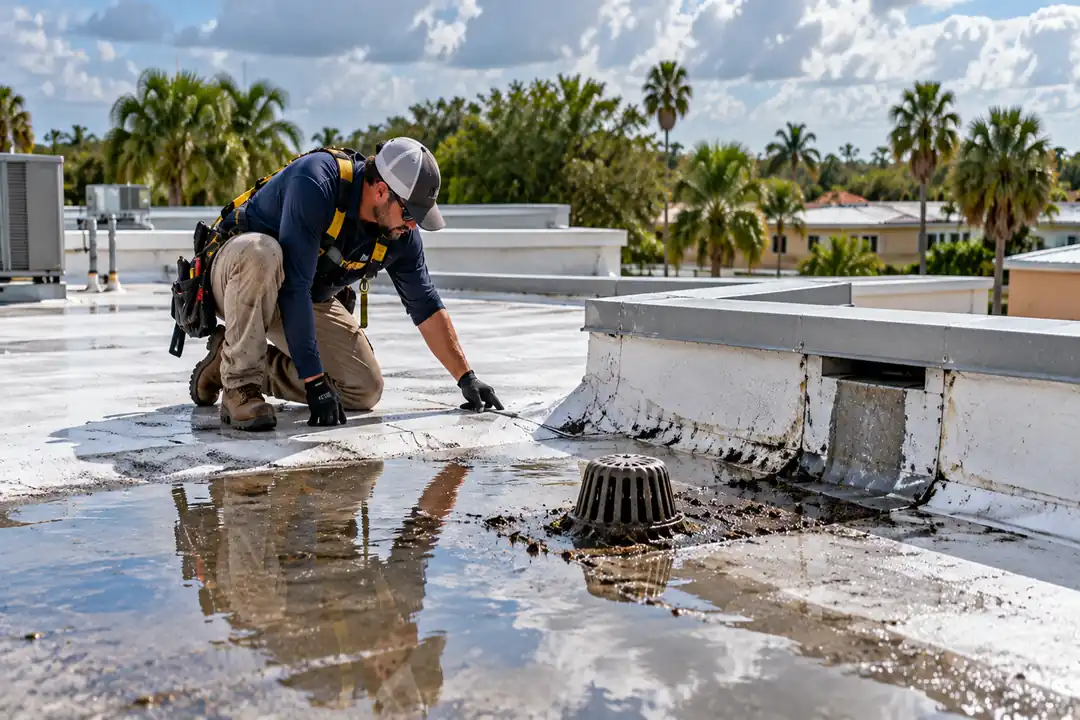
Roofing professionals use “ponding” for more than a puddle that appears during a storm. The National Roofing Contractors Association defines ponding as excessive water in a low area that remains more than 48 hours after precipitation when drying conditions are favorable. NRCA also defines positive drainage as a roof condition designed so water drains within that same 48-hour window.
That distinction matters. A shallow puddle that disappears as the roof drains and dries is different from water that repeatedly remains in the same depression long after surrounding areas are dry.
Photograph the same low area shortly after rain, again several hours later, and—only from a safe location—after a day or two. The duration and location are more useful than calling every temporary puddle “ponding.”
Low-slope roofs depend on deliberate drainage toward internal drains, scuppers, gutters, or roof edges. Water can collect when that path is interrupted or when the roof surface develops a low point.
Leaves, roof debris, organic buildup, or objects around a drain or scupper can slow discharge and cause water to back up across the membrane.
Deck deflection, compressed insulation, uneven substrate conditions, or older repairs can leave depressions where water collects.
A roof can look flat to the eye while still being designed with subtle slope. If the intended fall toward drainage is missing or interrupted, water can remain behind.
Parapets, equipment curbs, roof additions, and other obstructions can change how water reaches the nearest drain or scupper.
No. Ponding and leaking are related conditions, but they are not the same thing. A membrane in good condition may remain watertight even when water temporarily sits on it. The concern increases when standing water repeatedly exposes a weak seam, puncture, failed flashing, deteriorated patch, drain detail, or other membrane defect.
GAF notes that low-slope roofs collect water more quickly and drain more slowly than steep-slope roofs, and that prolonged standing water can contribute to premature membrane deterioration. That means the drainage problem and the membrane condition should be evaluated together.
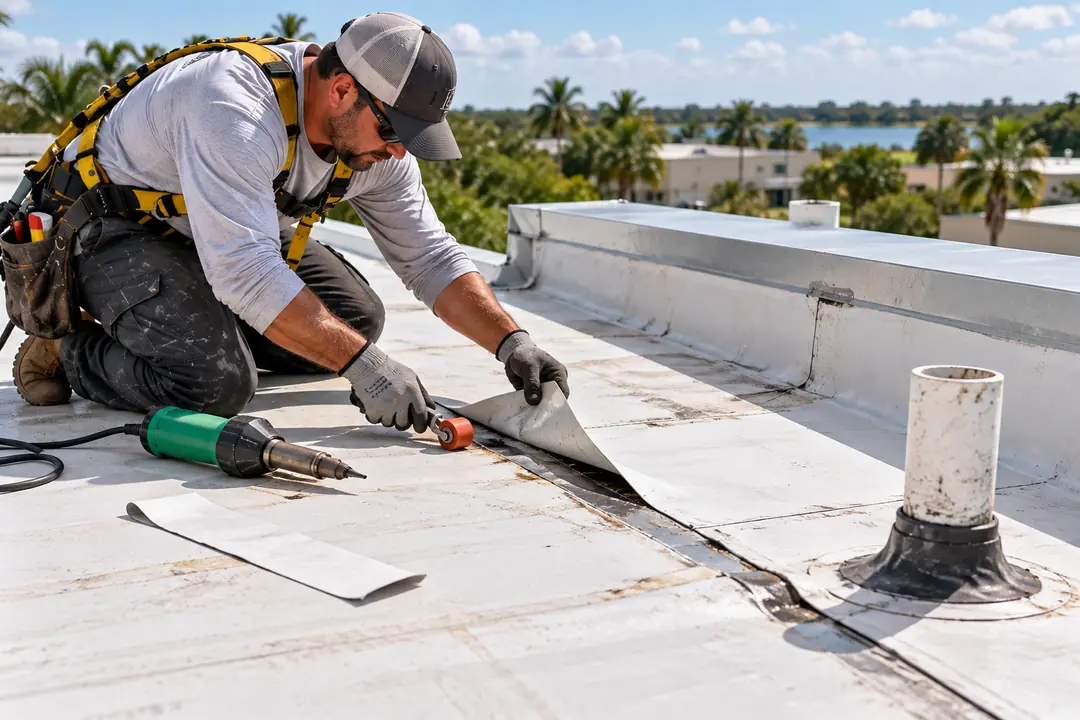
A flat-roof leak often starts at a detail rather than through the middle of an undamaged membrane sheet. Standing water can keep those details wet longer and reveal small weaknesses that may not leak during shorter exposure.
TPO and PVC systems use welded seams; other systems use different bonding or lap methods. Open, contaminated, poorly welded, or aging seams can become leak paths.
The membrane must connect correctly to the drain assembly. A damaged target patch, clamping detail, sealant interface, or surrounding low area can affect performance.
Pipes, vents, supports, and equipment curbs interrupt the field membrane and depend on compatible flashing details.
A prior repair can be completely serviceable—or it can become the weak point if the patch material, preparation, adhesion, or edges have failed.
Flat roof is a shape description, not a single roofing material. TPO, PVC, EPDM, modified bitumen, built-up roofing, and liquid-applied systems use different materials and detailing methods. A compatible repair starts by identifying the system before choosing a patch, adhesive, coating, or welding method.
For example, GAF’s TPO field guidance describes repairing open welds with compatible reinforced membrane and heat welding, followed by probing the cooled repair. That kind of membrane-specific procedure is very different from repairing an asphalt-based modified bitumen roof.
A product that sticks to one roof system is not automatically the right long-term repair for another. Membrane identification comes before material selection.
If the membrane is damaged but the roof drains normally, a localized membrane repair may be enough. If the membrane is sound but water consistently remains because the roof has a low spot or restricted drainage, patching the surface does not correct the underlying water-management problem.
Some roofs need both: repair the leak path and correct the condition that keeps water concentrated over the same vulnerable detail. A useful inspection separates the waterproofing defect from the drainage defect instead of treating them as one problem.
Lakeland’s warm-season storms can put a large amount of water on a roof quickly. That makes a restricted drain, low spot, or marginal membrane detail easier to notice than during a brief light shower. A roof that appears problem-free during dry weather can reveal a repeatable pattern after stronger rain.
If the same area ponds after multiple storms, record the location and approximate duration. If interior moisture appears at the same time, include that pattern when requesting Flat Roof Repair in Lakeland.
Do not walk a wet membrane roof to measure puddles or clear drainage during a storm. Flat roofs can still be slippery, and water can conceal damaged surfaces or openings.
Note whether the interior leak begins immediately or only after prolonged heavy rain.
From a safe observation point, note whether water disappears quickly or remains long after other areas dry.
Identify whether the wet area is around a drain, wall, pipe, vent, curb, seam, old patch, or roof edge.
Photograph ceiling stains or drips and note whether they line up roughly with a drain, parapet, or roof penetration.
NRCA defines ponding as excessive water that remains in a low roof area more than 48 hours after precipitation when conditions are favorable for drying.
No. The correct scope depends on why the water remains, the membrane condition, whether insulation or decking is wet, and whether the drainage condition can be corrected locally.
A restricted drain can cause water to remain over seams, penetrations, or other vulnerable details for longer. The drain condition and membrane should both be checked.
A coating or patch should not be chosen until the roof system, existing membrane condition, drainage problem, and moisture below the surface are understood.
These references provide general technical and local permitting context. They do not replace inspection of a specific roof assembly.
A useful flat-roof repair starts by identifying the membrane system, where water is collecting, and which detail is actually allowing water through.